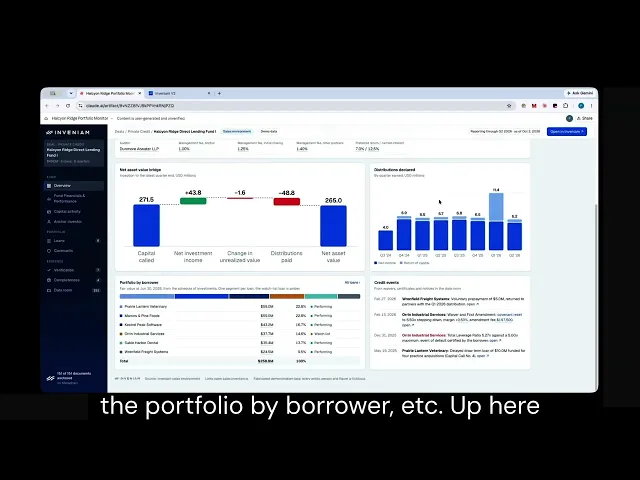
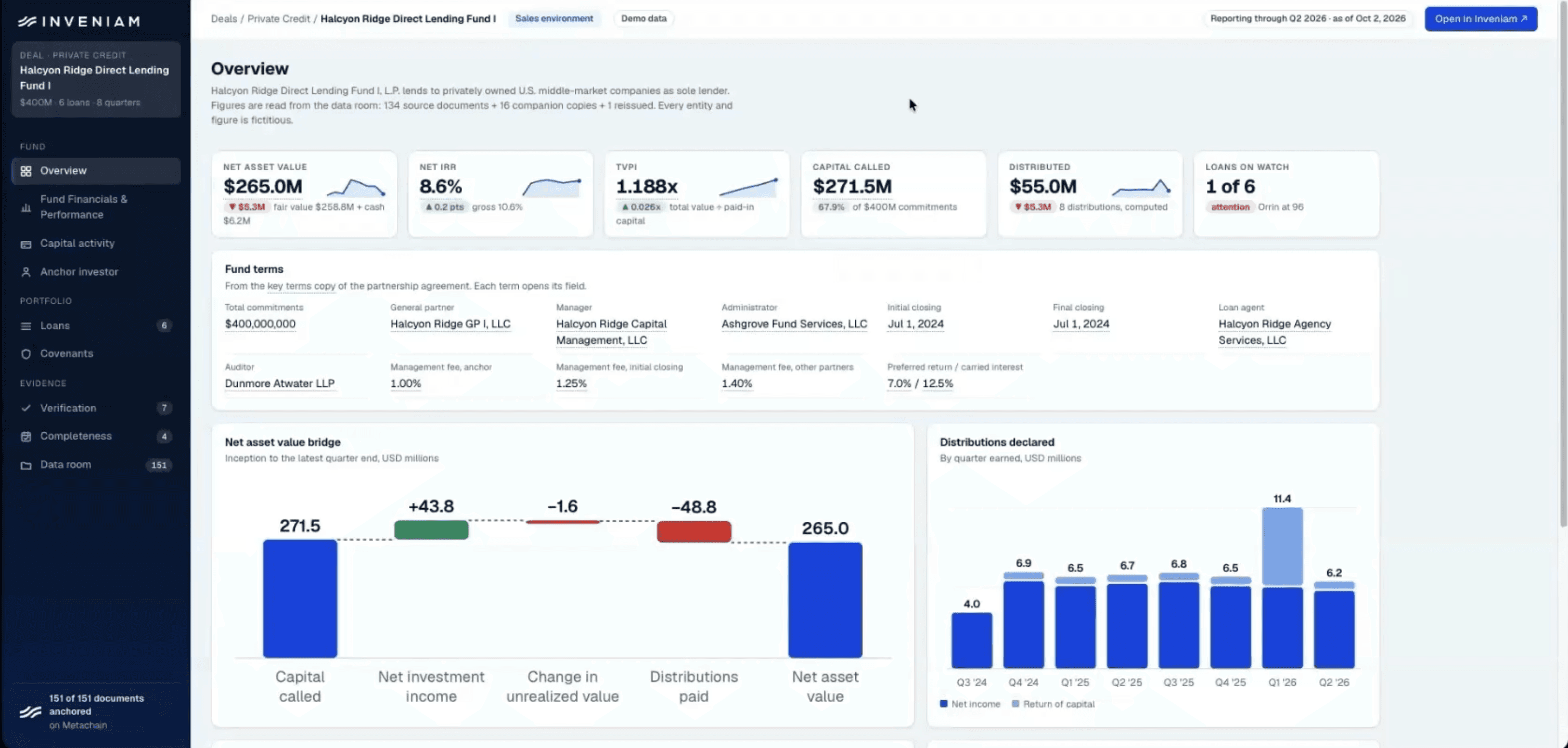
Continuous, audit-ready valuation for private credit and illiquid books—allowing outside verification down to the source page without sharing confidential underlying documents.
NOVI, Mich. and ABU DHABI, October 9, 2026. Inveniam Capital Partners, Inc. today introduced Proof of Illiquid Reserves, a standard solution that lets institutions mark hard-to-value assets continuously and prove any published figure to an outside party, without a document ever leaving the holder’s environment.
The solution extends proof of reserves beyond the question the practice has historically answered. Public wallet attestations and Merkle-tree proofs establish that an asset exists where an open ledger can already see it. They remain silent on private loans, structured holdings and strategic positions, and silent on what any of those assets are worth. Proof of Illiquid Reserves addresses all four pillars of reserve validation: existence, ownership, value, and coverage. It treats value–the critical element no prior method has made independently verifiable–as the core problem to be solved.
A Regulatory Turning Point Across Four Supervisors
The launch responds to a concentrated run of supervisory actions establishing how private and illiquid assets are valued:
SEC Fair Value Mandate (September 28, 2026): A joint statement from the SEC’s Chief Accountant and the Division of Investment Management affirmed that missing borrower information does not excuse the obligation to estimate fair value, emphasized testing models against current credit spreads and comparable trades, and cautioned that the net asset value (NAV) practical expedient is not a safe harbor.
NAIC Private Asset Disclosures (Year-end 2026): The National Association of Insurance Commissioners requires insurers to report private asset valuations, exposure to complex valuation inputs, and reliance of private letter ratings.
GENIUS Act Implementation (Jan. 18, 2027): Tightens reserve standards for stablecoin issuers, followed by restrictions on distribution through US platforms taking effect on July 18, 2028.
AICPA Stablecoin Criteria (Part II, Jan. 2026): Updated reporting standards pivot from passive snapshot holdings to active, tested operational controls around underlying reserves.
Together these measures bear directly on roughly $3.5 trillion in global private credit assets under management, more than $500 billion in US life insurer private placements, and an evergreen and semi-liquid fund sector approaching $500 billion in assets after growing more than 30 percent in a year.
"Proof of reserves, as historically practiced, answers the easy question. A public wallet attestation confirms an asset exists where a ledger can already see it, but it reveals nothing about a private loan and nothing about what an illiquid position is actually worth," said Patrick O’Meara, Chief Executive Officer of Inveniam Capital Partners. "Value is the single threshold where institutional capital pauses, and it is the leg no one has made provable. That is the problem we built Proof of Illiquid Reserves to solve."
How It Works: Zero-Knowledge Verification at the Page Level
Proof of Illiquid Reserves processes a holder’s documents where they already reside. Open DGML, Inveniam’s open document format (published under Apache 2.0), parses credit agreements, covenant certificates, borrower financials, collateral reports, custody records and valuations into typed, named elements that retain their precise page coordinates within a specific document version. Those elements serve as immutable inputs into published valuation methodology, version-controlled by asset class, and signed by an independent valuation agent.
The computation executes on whatever cadence the holder chooses: monthly, daily, or multiple fixes per day synced to live market data feeds. At each mark, it anchors cryptographic hashes of the underlying element, the input vector, the method version, and the resulting calculation to the NVNM Chain. Counterparties can independently confirm that a published figure derives from an exact page and line of a specific document version without receiving the underlying proprietary file, and without requiring trust in either the asset holder or Inveniam.
Every movement in a published figure is decomposed into observable market shifts and documented corporate events. Any calculation variance that cannot be traced to a named input prevents publication, and any material variance breach between independent pricing feeds suspends publication rather than resolving by default in the holder’s favor.
Institutional Independence Built into Every Mark
Published figures rely on strict operational separation where three independent parties fulfill separate, non-overlapping functions:
Methodology: An independent valuation agent authors, owns and cryptographically signs the valuation model.
Computation: Inveniam computes the valuation against attested document inputs.
Recalculation: A fund administrator recalculates the identical figure from the same source inputs and countersigns the final output. Apex Group, Inveniam’s Valuation-as-a-Service partner since 2022, provides this independent recomputation.
Verification is structured across three tiers:
Continuous Machine Verification: Available on demand to any counterparty holding a hash, requiring no access to proprietary borrower files and no bilateral engagement letter.
Periodic Agreed-Upon Procedures (AUP): Conducted by an independent accounting firm on a statistical sample of valuation marks.
Annual Financial Statement Audit: Financial statement auditors consume the cryptographic chain of custody as primary audit evidence rather than having to reconstruct valuations from scratch.
"Every institution holding an illiquid book has the same difficult conversation with its auditor, regulator, and investors, and it always comes back to the same fact: the firm marking the asset is the firm that owns it," said Richard Walker, President of Inveniam IO. "We eliminate that structural conflict. By separating the methodology from the asset holder and anchoring every input to its physical source page, marking your own book ceases to be a conflict of interest because anyone can verify the work."
Availability and Pilot Program
Proof of Illiquid Reserves is available immediately as an enterprise solution, supported by:
Standard Methodology Library: Standardized valuation methods, automated ingestion templates, and compliance controls pre-mapped to ASC 820 fair-value standards and AICPA criteria.
90-Day Proof of Concept: A structured pilot executed on a single designated asset sleeve, culminating when an independent outside firm verifies a published figure directly back to its source page.
Platform-Agnostic Token Wrapper: An optional transfer-restricted, book-entry token wrapper is available for issuers requiring a reserve position to maintain a single authoritative, on-chain state. The wrapper integrates across major institutional tokenization platforms without requiring clients to migrate to a proprietary issuance rail.